Account-Based Marketing (ABM) Automation for B2B: Low-Code Playbooks with Make & n8n

Account-Based Marketing (ABM) Automation for B2B: Low-Code Playbooks with Make & n8n
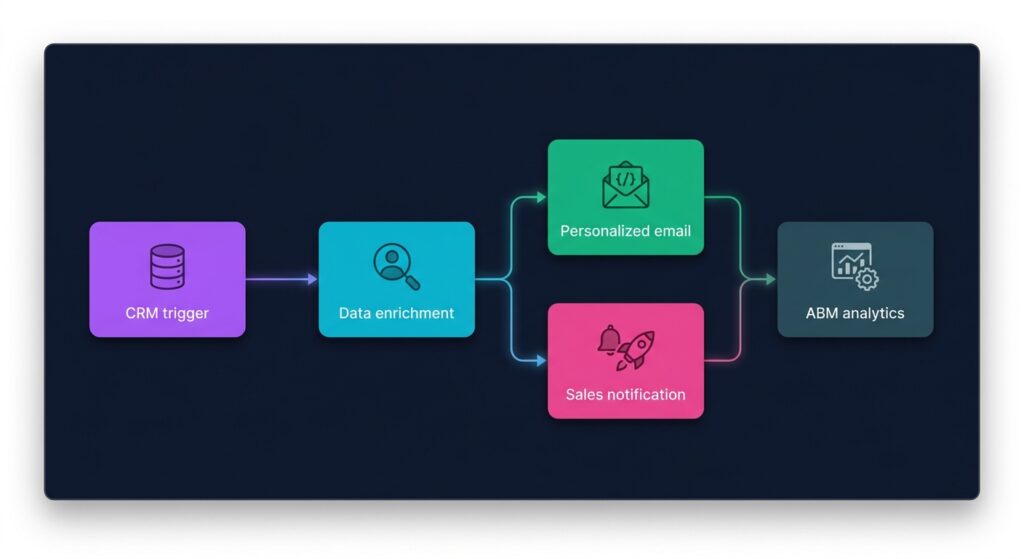
In today’s competitive B2B landscape, a one-size-fits-all marketing approach simply doesn’t cut it. Account-Based Marketing (ABM) has emerged as a powerful strategy, focusing marketing and sales efforts on a defined set of target accounts. However, executing ABM at scale can be resource-intensive. This is where low-code ABM automation for B2B services becomes a game-changer. By leveraging intuitive platforms like Make (formerly Integromat) and n8n, businesses can build sophisticated, automated ABM playbooks without requiring extensive coding expertise. This post will explore the benefits of ABM automation, introduce Make and n8n, and provide actionable insights into creating your own low-code ABM workflows.
Why ABM Automation is Crucial for B2B Success
Traditional marketing often casts a wide net, hoping to catch a few valuable leads. ABM, conversely, is about precision. It involves identifying high-value accounts, understanding their unique needs, and delivering personalized campaigns across multiple touchpoints. While the strategy is sound, the manual execution of tasks like data enrichment, personalized content delivery, and multi-channel outreach can quickly become overwhelming. ABM automation addresses these challenges by:
- Increasing Efficiency: Automating repetitive tasks frees up your sales and marketing teams to focus on high-value activities like strategic planning and personalized engagement.
- Enhancing Personalization: Automation allows for dynamic content and messaging tailored to specific account needs, industry trends, and individual buyer personas.
- Improving Data Accuracy and Consistency: By centralizing data and automating updates, you reduce the risk of errors and ensure a single source of truth for account information.
- Accelerating Sales Cycles: Timely and relevant communication, triggered by specific account actions, can significantly shorten the time from initial contact to closed deal.
- Boosting ROI: By focusing resources on the most promising accounts and delivering highly relevant experiences, ABM automation leads to higher conversion rates and a better return on marketing investment.
The Power of Low-Code Automation Platforms: Make & n8n
The beauty of low-code platforms lies in their visual interfaces and pre-built connectors, which abstract away much of the underlying complexity of traditional programming. Make and n8n are leading examples of such platforms, empowering businesses to build powerful integrations and automated workflows with minimal coding.
Make (formerly Integromat): Visual Workflow Building
Make is a robust visual platform that allows you to connect different apps and services to automate tasks and workflows. Its intuitive drag-and-drop interface makes it easy to design complex scenarios by linking modules representing various applications and actions. Make excels at:
- Connecting a vast array of applications: With hundreds of pre-built integrations, Make can connect your CRM, marketing automation tools, data enrichment services, communication platforms, and more.
- Building complex logic: You can implement conditional logic, data transformations, scheduling, and error handling within your workflows.
- Real-time data processing: Make can process data as it comes in, enabling immediate responses to account activities.
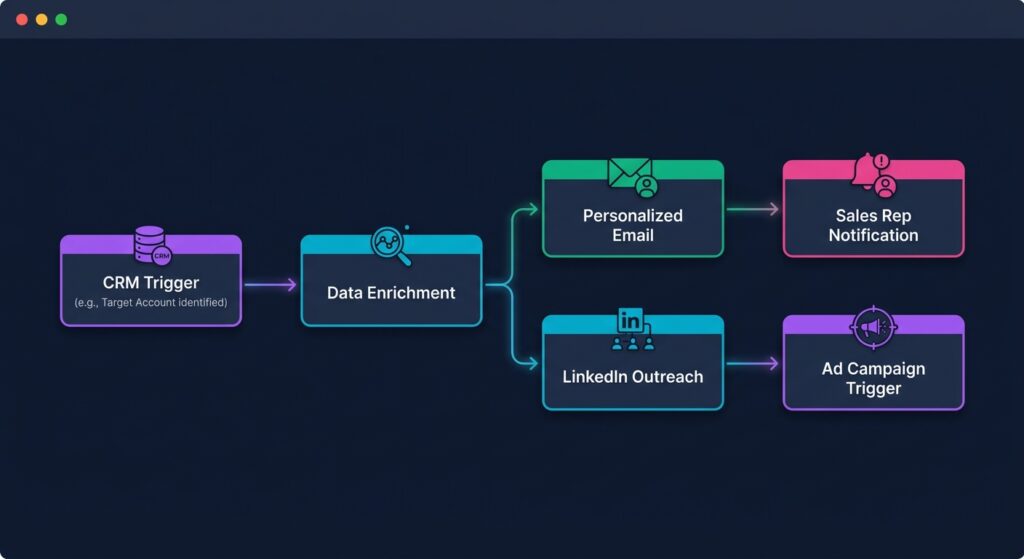
For ABM, Make can be instrumental in automating tasks such as:
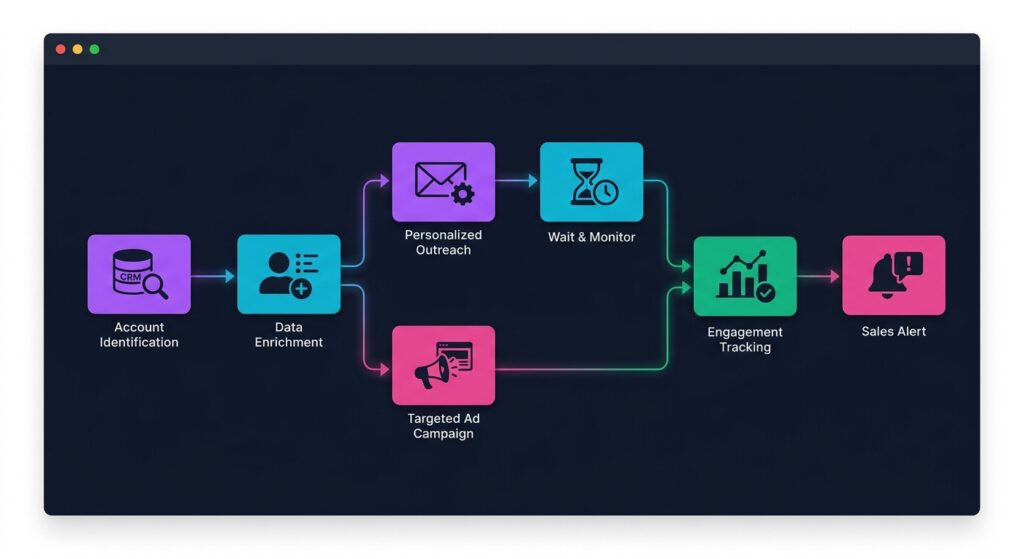
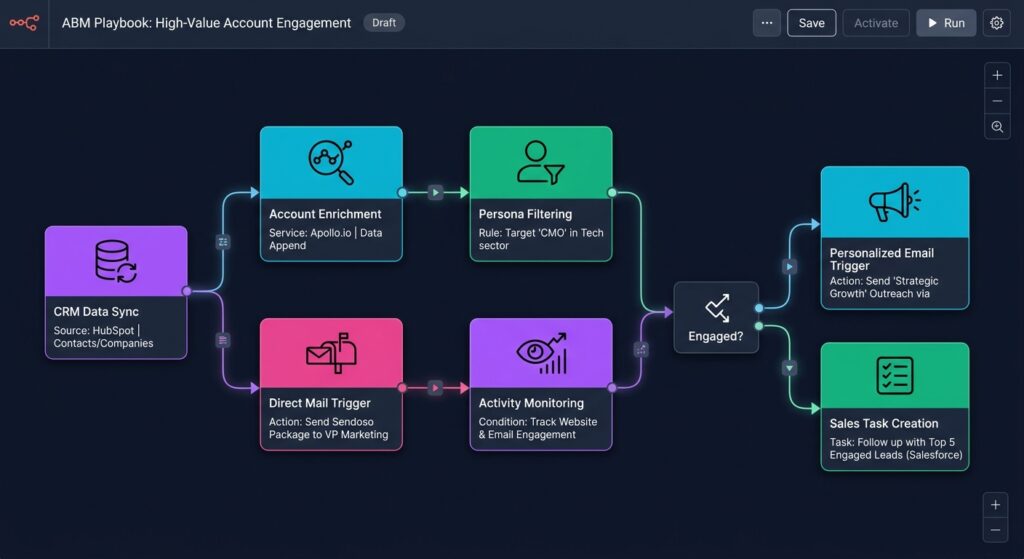
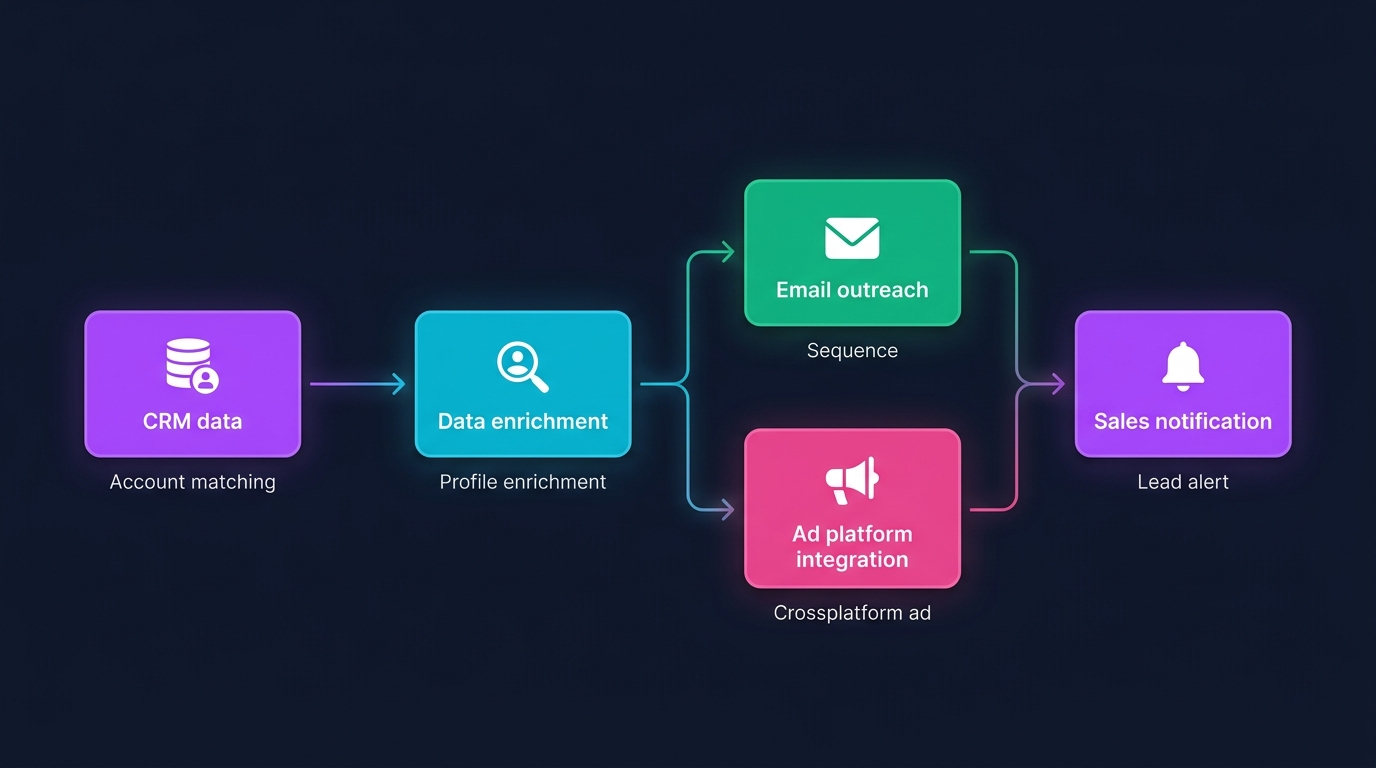
- Enriching lead data from your CRM with firmographic and technographic information.
- Triggering personalized email sequences based on account engagement signals.
- Adding target accounts to specific advertising audiences.
- Notifying sales reps when a key contact at a target account visits your website.
n8n: Open-Source Flexibility and Control
n8n is an open-source workflow automation tool that offers a powerful and flexible alternative. It provides a visual editor for building workflows, similar to Make, but with the added advantage of being self-hostable, offering greater control over data and infrastructure. n8n is ideal for:
- Custom integrations: While it has many pre-built nodes, n8n’s open-source nature makes it easier to build custom integrations for niche tools.
- Data privacy and security: Self-hosting gives you complete control over your data, which is crucial for sensitive B2B information.
- Cost-effectiveness: For high-volume usage, the open-source model can be more cost-effective.
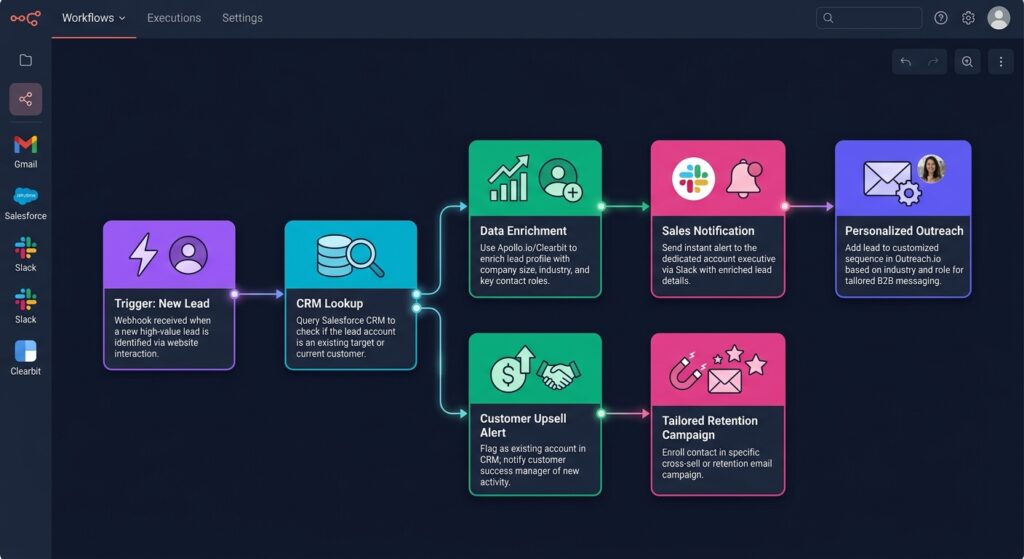
In an ABM context, n8n can power workflows like:
- Syncing account data between your CRM and sales enablement platforms.
- Automating the creation of personalized outreach sequences in sales engagement tools.
- Monitoring social media for mentions of target accounts and triggering alerts.
- Segmenting accounts based on custom criteria and adding them to targeted campaigns.
Building Your Low-Code ABM Playbooks: A BMAIKR Approach
At BMAIKR, we understand the transformative power of integrating advanced technologies with strategic marketing. Our expertise in AI and Business Automation allows us to design and implement bespoke ABM automation solutions tailored to your unique business needs. We leverage platforms like Make and n8n to create efficient, personalized, and scalable ABM playbooks.
Why Choose BMAIKR for Your ABM Automation?
Navigating the complexities of ABM and automation requires specialized knowledge. Here’s why BMAIKR stands out:
- Strategic ABM Expertise: We don’t just build workflows; we help you define your ABM strategy, identify target accounts, and map out personalized customer journeys.
- Deep Technical Proficiency: Our team has extensive experience with low-code platforms like Make and n8n, as well as the underlying technologies that power them. We understand how to connect these tools seamlessly with your existing tech stack.
- Customized Solutions: We recognize that every business is unique. We craft ABM automation playbooks that align with your specific goals, target audience, and operational processes.
- Focus on ROI: Our primary objective is to deliver measurable results. We design automations that drive efficiency, improve engagement, and ultimately, increase revenue.
- End-to-End Service: From initial strategy and platform selection to implementation, testing, and ongoing optimization, BMAIKR provides comprehensive support throughout your ABM automation journey.
- Integration with Web Development and Digital Marketing: We understand how ABM automation fits into the broader digital ecosystem. Our Web Development services ensure your digital presence supports your ABM efforts, and our Digital Marketing expertise ensures your campaigns reach the right accounts with the right message.
Common Low-Code ABM Automation Playbooks
Let’s explore some practical examples of ABM playbooks you can build with Make or n8n:
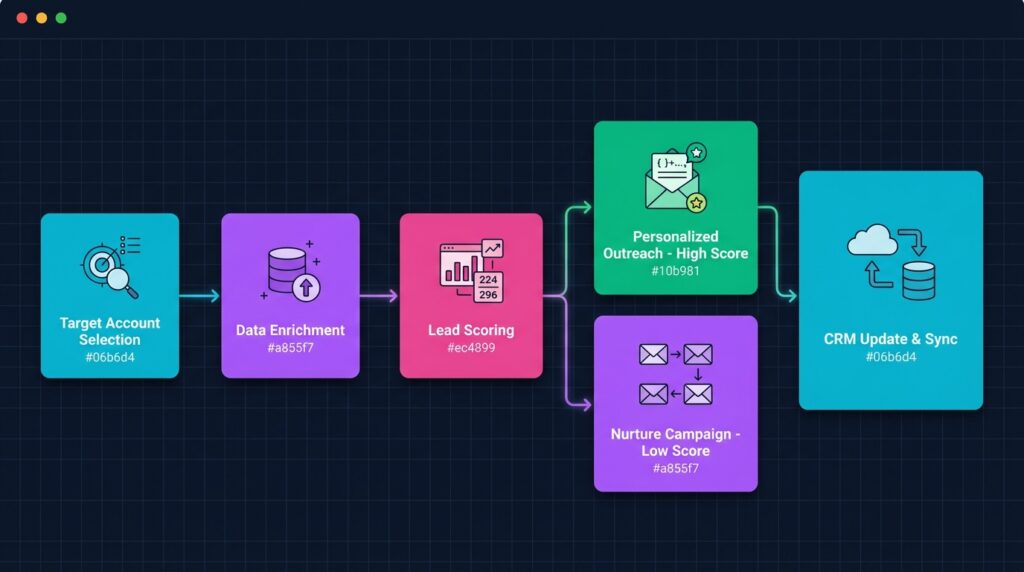
Playbook 1: Dynamic Account Scoring and Prioritization
Goal: Automatically score and prioritize target accounts based on engagement and firmographic data.
Workflow:
- Trigger: A new lead is added to your CRM, or an existing contact at a target account interacts with your content (e.g., website visit, email open).
- Data Enrichment: Use tools like Clearbit or Hunter.io (via Make/n8n connectors) to enrich the account’s firmographic and technographic data.
- Engagement Tracking: Pull data from your marketing automation platform (e.g., HubSpot, Marketo) or website analytics to track engagement metrics (page views, content downloads, webinar attendance).
- Scoring Logic: Apply custom scoring rules based on firmographics (industry, company size) and engagement levels.
- CRM Update: Update the account’s score and priority level directly in your CRM.
- Notification: Alert the assigned sales rep via Slack or email when an account reaches a high-priority threshold.
Playbook 2: Personalized Content Delivery for Target Accounts
Goal: Deliver highly relevant content to key stakeholders within target accounts.
Workflow:
- Trigger: An account is identified as high-priority or a specific trigger event occurs (e.g., visiting a product page).
- Identify Key Contacts: Query your CRM to identify key decision-makers and influencers within that account.
- Content Mapping: Based on the account’s industry, challenges (identified through data enrichment), and the trigger event, select the most relevant content assets (case studies, whitepapers, blog posts).
- Personalized Email/Message: Craft a personalized email or LinkedIn message incorporating the selected content. Use placeholders for contact name, company name, and specific pain points.
- Send via Sales Engagement Tool: Integrate with tools like Outreach or SalesLoft to send the personalized message.
- Track Opens and Clicks: Monitor engagement with the sent message.
Playbook 3: Targeted Advertising Audience Synchronization
Goal: Ensure your advertising campaigns are precisely targeted to your defined ABM accounts.
Workflow:
- Trigger: A new account is added to your target list in the CRM, or an account’s status changes.
- Extract Account Data: Pull the list of target accounts and their associated company domains or IP addresses.
- Audience Creation/Update: Connect to advertising platforms like LinkedIn Ads or Google Ads. Create or update custom audiences with the extracted account information.
- Campaign Activation: Ensure that specific ad campaigns are associated with these newly updated audiences.
- De-prioritization: When an account is no longer a target, remove it from the advertising audience to avoid wasted spend.
Choosing the Right Platform for Your Needs
Both Make and n8n are powerful tools, but they cater to slightly different needs and preferences:
When to Choose Make:
- You prioritize a highly intuitive, visual interface with a vast library of pre-built integrations.
- Your team is less technically inclined and benefits from a user-friendly drag-and-drop experience.
- You need to connect a wide range of SaaS applications quickly and efficiently.
- You are comfortable with a SaaS subscription model.
When to Choose n8n:
- You require greater control over your data and infrastructure, especially for privacy-sensitive information.
- You have a strong preference for open-source solutions and the flexibility they offer.
- Your team has some technical expertise and can manage self-hosted deployments.
- You need to build highly custom integrations or have complex internal systems to connect.
- Cost optimization for high-volume automation is a key consideration.
Ultimately, the best platform depends on your team’s technical skills, infrastructure preferences, budget, and the specific complexity of your ABM automation needs. Many businesses find value in using both platforms for different use cases.
The Future of ABM Automation
As AI continues to evolve, we can expect even more sophisticated ABM automation capabilities. Predictive analytics will become more integrated, allowing for even more accurate account scoring and proactive engagement strategies. Natural Language Processing (NLP) will enable more nuanced analysis of account communications and sentiment. Low-code platforms will continue to democratize access to these advanced capabilities, making powerful ABM automation accessible to a broader range of businesses.
Ready to Supercharge Your ABM Strategy?
Implementing effective ABM automation requires a strategic approach and the right technical expertise. Don’t let manual processes hold your B2B growth back. BMAIKR specializes in designing and implementing custom low-code ABM automation playbooks using platforms like Make and n8n. We help you streamline your operations, personalize your outreach, and drive measurable results.
Contact BMAIKR today for a consultation and discover how we can transform your ABM strategy with intelligent automation.