Quantifying Success: A B2B Guide to Measuring and Maximizing ROI from AI & Low-Code Automation


Quantifying Success: A B2B Guide to Measuring and Maximizing ROI from AI & Low-Code Automation
In today’s competitive B2B landscape, the adoption of advanced technologies like Artificial Intelligence (AI) and low-code automation platforms is no longer a luxury but a necessity. These tools promise increased efficiency, streamlined workflows, and enhanced decision-making. However, the true value of any technological investment lies in its return on investment (ROI). For B2B organizations, understanding how to effectively measure and maximize the ROI from AI and low-code automation is paramount. This guide will delve into the critical strategies for B2B automation ROI measurement strategies, helping you transform your technology investments into tangible business growth.
The Promise of AI and Low-Code Automation in B2B
Before we dive into measurement, let’s briefly touch upon why these technologies are so transformative for B2B businesses. AI, with its capabilities in data analysis, predictive modeling, and intelligent task execution, can unlock new levels of operational excellence. Low-code platforms, on the other hand, democratize application development and process automation, allowing businesses to build and deploy solutions rapidly without extensive traditional coding expertise. Together, they create a powerful synergy that can:
- Automate repetitive manual tasks, freeing up human capital for more strategic work.
- Improve data accuracy and reduce errors through intelligent processing.
- Accelerate business processes, from customer onboarding to order fulfillment.
- Enhance customer experiences through personalized interactions and faster service.
- Provide deeper insights into business operations and market trends.
Why Measuring ROI is Crucial for B2B Automation
Implementing AI and low-code solutions can involve significant upfront costs, including software licenses, integration efforts, training, and ongoing maintenance. Without a clear understanding of the ROI, it’s difficult to justify these expenditures, secure further investment, or identify areas for optimization. Effective ROI measurement allows B2B leaders to:
- Justify Investments: Demonstrate the tangible benefits of technology adoption to stakeholders and secure budget for future initiatives.
- Optimize Performance: Identify which automation strategies are delivering the highest returns and which may need adjustment or discontinuation.
- Drive Strategic Decisions: Use data-driven insights to inform future technology roadmaps and business strategies.
- Benchmark Success: Compare the performance of automation initiatives against industry standards and internal goals.
- Foster Accountability: Create a culture of performance and accountability around technology investments.
Key Metrics for Quantifying B2B Automation ROI
Quantifying the ROI of AI and low-code automation requires a multi-faceted approach, considering both direct financial gains and indirect operational improvements. Here are key metrics to track:
Direct Financial Metrics
1. Cost Reduction
This is often the most straightforward metric. It involves calculating the savings achieved by automating tasks that were previously performed by human resources or through less efficient, more expensive methods. This includes:
- Reduced labor costs (salaries, benefits, training for tasks now automated).
- Lower operational expenses (e.g., reduced paper usage, fewer errors leading to rework).
- Decreased software or tool expenses if automation replaces multiple disparate systems.
Calculation: (Previous Cost of Task/Process) – (Current Cost of Automated Task/Process) = Cost Savings.
2. Revenue Increase
AI and automation can directly or indirectly lead to increased revenue. This can be achieved through:
- Improved lead generation and qualification through AI-powered tools.
- Faster sales cycles due to streamlined processes.
- Enhanced customer retention and upsell opportunities driven by personalized experiences.
- New product or service offerings enabled by automation capabilities.
Calculation: (New Revenue Attributed to Automation) – (Investment in Automation) = Revenue Gain.
3. Productivity Gains (Monetized)
While productivity is often seen as an operational metric, it can be monetized. If an employee’s time is freed up by automation, that time can be reallocated to higher-value activities that generate revenue or reduce costs. Quantifying this involves assigning a monetary value to that freed-up time.
Calculation: (Hours Saved per Employee per Period) * (Average Hourly Cost per Employee) * (Number of Employees) = Monetized Productivity Gain.
Indirect Operational Metrics
4. Efficiency and Speed Improvements
Measure the reduction in time taken to complete specific tasks or processes. While not directly financial, significant improvements here often translate to cost savings or revenue acceleration.
- Time to complete a customer support ticket.
- Time to onboard a new client.
- Time to process an invoice.
5. Error Rate Reduction
AI and automation excel at reducing human error. Track the decrease in mistakes, which can lead to significant cost savings from rework, customer dissatisfaction, or compliance issues.
- Percentage reduction in data entry errors.
- Decrease in order fulfillment mistakes.
- Reduction in compliance breaches.
6. Customer Satisfaction (CSAT) and Net Promoter Score (NPS)
Improved customer experiences, often a direct result of faster service, personalized interactions, and fewer errors, can be measured through CSAT and NPS scores. Higher scores often correlate with increased customer loyalty and lifetime value.
7. Employee Satisfaction and Retention
Automating mundane and repetitive tasks can significantly boost employee morale and job satisfaction. This can lead to reduced turnover, saving on recruitment and training costs.
Implementing a Robust ROI Measurement Framework
To effectively measure and maximize your B2B automation ROI, consider the following strategic steps:
1. Define Clear Objectives and KPIs Before Implementation
Before deploying any AI or low-code solution, clearly define what success looks like. What specific problems are you trying to solve? What are the measurable outcomes you expect? Align these objectives with your overall business goals and establish Key Performance Indicators (KPIs) that will track progress.
2. Establish a Baseline
Understand your current state. Before implementing automation, meticulously document the performance metrics of the processes you intend to automate. This baseline is crucial for accurately calculating the improvements and ROI.
3. Choose the Right Tools for Measurement
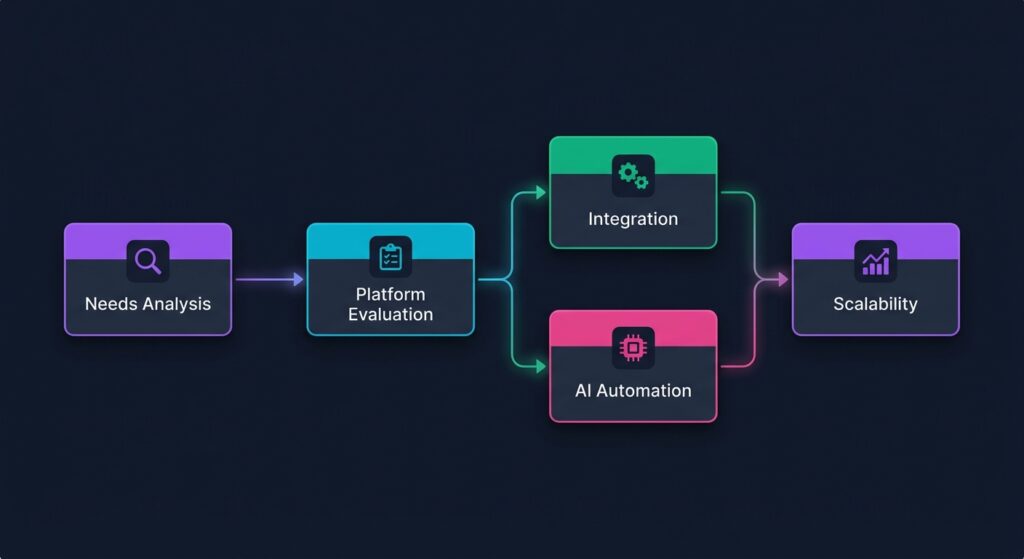
Leverage your existing analytics tools, business intelligence platforms, or specialized ROI tracking software. For complex workflows, consider using platforms that offer built-in analytics or can integrate with your data sources. For instance, robust workflow automation tools can often provide detailed insights into process times and resource allocation.
4. Track Both Direct and Indirect Benefits
Don’t solely focus on immediate cost savings. Ensure you have mechanisms in place to capture the value of improved efficiency, enhanced customer satisfaction, and increased employee morale. These indirect benefits often contribute significantly to long-term business success.
5. Attribute Value Accurately
This can be challenging. For example, if a sales process is improved by both a new CRM feature (web development) and an AI-powered lead scoring tool, how do you attribute the revenue increase? Use methodologies like A/B testing, control groups, or statistical modeling to isolate the impact of specific automation initiatives.
6. Calculate the Total Cost of Ownership (TCO)
ROI isn’t just about the benefits; it’s also about the total cost. Include all associated costs: software, hardware, implementation, integration, training, maintenance, and any ongoing support fees. A comprehensive TCO provides a realistic denominator for your ROI calculation.
7. Regularly Review and Iterate
ROI measurement is not a one-time activity. Continuously monitor your KPIs, analyze the data, and identify opportunities for optimization. As your business evolves and technology advances, your automation strategies and their ROI potential will also change.
Maximizing Your Automation ROI: Strategies for B2B Success
Measuring ROI is only half the battle. The real goal is to maximize it. Here’s how B2B organizations can ensure they’re getting the most out of their AI and low-code automation investments:
1. Start with High-Impact, Low-Complexity Processes
For initial automation projects, target processes that are repetitive, rule-based, and have a clear, measurable impact. This allows for quick wins, builds internal momentum, and provides valuable learning experiences before tackling more complex challenges.
2. Foster a Culture of Automation
Encourage employees to identify opportunities for automation within their roles. Provide training and resources to empower them to leverage low-code tools or suggest AI integrations. When automation is seen as an enabler rather than a threat, adoption and innovation flourish.
3. Integrate Seamlessly with Existing Systems
The true power of automation is unlocked when it works harmoniously with your existing technology stack. Invest in robust integration strategies to ensure data flows smoothly between your AI tools, low-code platforms, CRM, ERP, and other critical business systems. This is where expert web development services can be invaluable, ensuring your digital infrastructure is optimized for automation.
4. Focus on User Experience (Internal and External)
Whether automating internal workflows or customer-facing processes, prioritize a positive user experience. Clunky or confusing automated systems can negate the benefits. Ensure that automated interactions are intuitive, efficient, and meet user expectations.
5. Leverage AI for Continuous Improvement
Use AI not just for task automation but also for analyzing the performance of your automation itself. AI can identify bottlenecks, predict potential issues, and suggest optimizations for your automated workflows, creating a virtuous cycle of improvement.
6. Scale Strategically
Once you’ve proven the ROI of initial automation projects, develop a clear strategy for scaling these successes across the organization. This involves standardizing processes, creating reusable automation components, and ensuring adequate infrastructure and support.
7. Stay Agile and Adaptable
The landscape of AI and low-code is constantly evolving. Regularly review your automation strategy, stay abreast of new technologies, and be prepared to adapt your approach to maintain a competitive edge and maximize your ROI.
Choosing the Right Path: When to Prioritize AI vs. Low-Code Automation
While AI and low-code automation often work hand-in-hand, understanding their distinct strengths can help you prioritize investments and tailor your approach for maximum ROI.
When to Prioritize AI-Driven Automation:
- Complex Decision-Making: When processes require nuanced judgment, pattern recognition, or predictive analytics that go beyond simple rule-based logic. Examples include fraud detection, advanced customer segmentation, or predictive maintenance.
- Unstructured Data Processing: AI excels at understanding and processing unstructured data like text, images, and audio, which is common in areas like document analysis, sentiment analysis, or image recognition.
- Personalization at Scale: Delivering highly personalized customer experiences, product recommendations, or marketing messages based on vast amounts of user data.
- Continuous Learning and Adaptation: When the process needs to learn and improve over time based on new data and outcomes, such as in dynamic pricing or adaptive learning platforms.
- Natural Language Processing (NLP): For tasks involving understanding and generating human language, such as chatbots, automated summarization, or translation services.
When to Prioritize Low-Code Automation:
- Streamlining Repetitive Workflows: For automating well-defined, rule-based processes that involve moving data between systems, approving requests, or triggering standard notifications.
- Rapid Application Development: Quickly building internal tools, portals, or simple applications to address specific business needs without extensive traditional coding.
- Process Orchestration: Connecting disparate systems and applications to create seamless end-to-end business processes, ensuring smooth data flow and task handoffs.
- Citizen Development: Empowering business users (non-developers) to build and manage their own automations and applications, fostering agility and reducing IT backlogs.
- Integration of Existing Systems: Easily connecting legacy systems with modern applications or cloud services, often a complex task for traditional development.
Often, the most powerful solutions combine both. For example, a low-code platform might orchestrate a workflow that includes an AI model for intelligent data analysis. Understanding your specific business challenge will guide which technology, or combination thereof, will yield the best results and the highest ROI. For businesses looking to build sophisticated, integrated automated solutions, expert AI and Business Automation services are crucial.
Conclusion: Drive Growth Through Measurable Automation
The journey to successful AI and low-code automation in B2B is paved with data. By diligently measuring your ROI, focusing on both financial and operational gains, and strategically implementing and scaling your automation initiatives, you can unlock significant business value. Don’t let your technology investments remain abstract promises; quantify their success, optimize their performance, and drive sustainable growth.
Ready to transform your business with intelligent automation and measure its success?
Contact BMAIKR today for a consultation and let us help you define, implement, and quantify your automation ROI.