
Beyond Segmentation: Automating Hyper-Personalized B2B Email Campaigns with AI & Low-Code Platforms

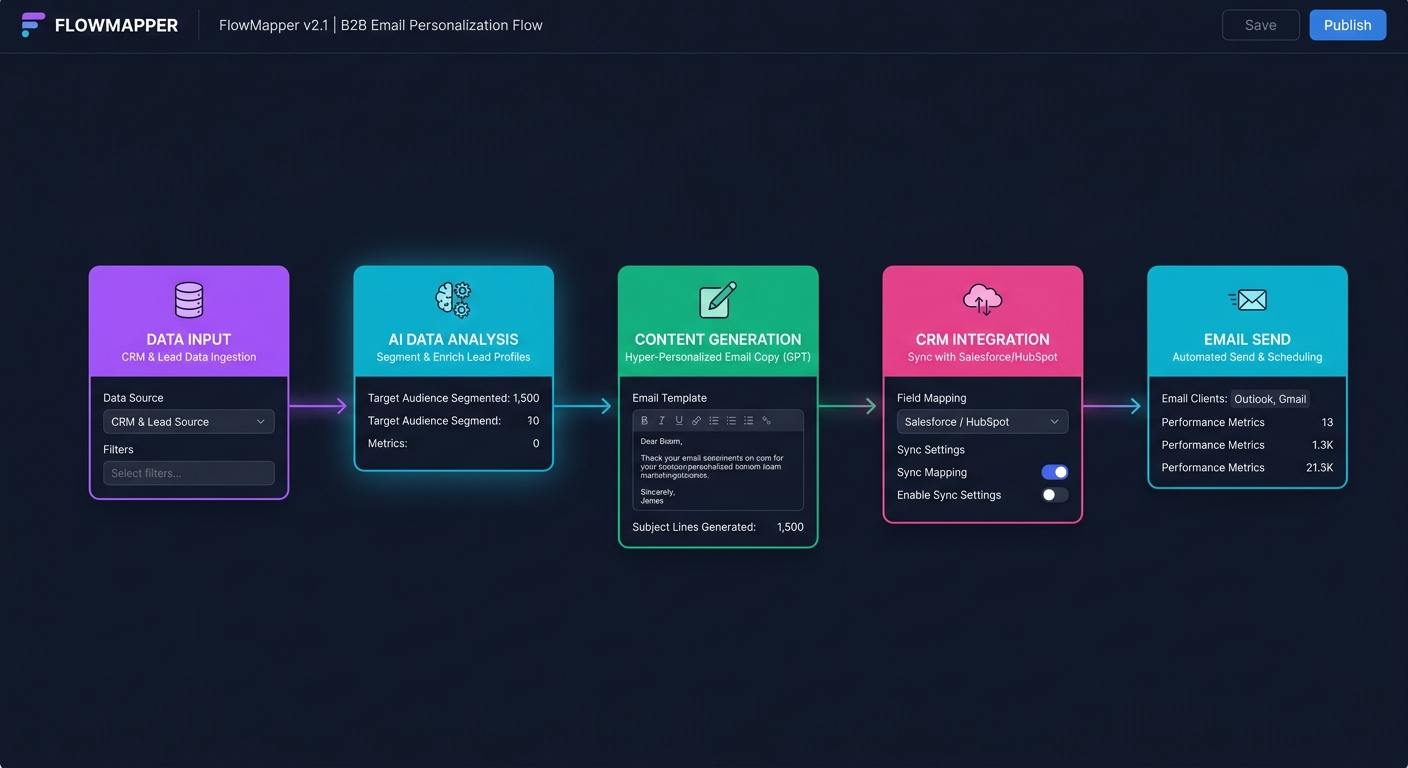
Beyond Segmentation: Automating Hyper-Personalized B2B Email Campaigns with AI & Low-Code Platforms
In today’s competitive B2B landscape, generic email blasts are a relic of the past. Buyers expect relevance, and delivering it at scale requires more than just basic segmentation. The future lies in AI-powered hyper-personalization for B2B email marketing automation. This advanced approach leverages artificial intelligence and modern low-code platforms to craft unique, highly targeted messages that resonate with individual prospects and customers. At BMAIKR, we understand the transformative power of this strategy and how it can drive significant engagement and conversion rates. This article will explore why hyper-personalization is essential, how AI and low-code platforms make it achievable, and how you can implement it to elevate your B2B outreach.
The Evolution of B2B Email Marketing: From Mass Blasts to Hyper-Personalization
For years, B2B marketers relied on broad segmentation based on industry, company size, or job title. While a step up from one-size-fits-all messaging, this approach still falls short of true personalization. Prospects are individuals with unique pain points, motivations, and stages in their buying journey. Generic emails, even if targeted to a segment, often fail to address these specific nuances, leading to low open rates, high unsubscribe rates, and missed opportunities.
Hyper-personalization goes deeper. It involves tailoring content, offers, and even the timing of your emails based on a granular understanding of each individual recipient. This includes their past interactions with your brand, their browsing behavior on your website, their expressed interests, and even their professional background. The goal is to make each recipient feel as though the email was crafted specifically for them, fostering a stronger connection and increasing the likelihood of a positive response.
Why Generic Segmentation Isn’t Enough Anymore
- Lack of Individual Relevance: Even within a segment, individuals have diverse needs and preferences.
- Low Engagement Rates: Generic content is easily ignored in crowded inboxes.
- Missed Conversion Opportunities: Failing to address specific pain points means failing to offer the right solution at the right time.
- Brand Perception: A lack of personalization can signal a lack of understanding or care for the prospect.
The Power Duo: AI and Low-Code Platforms for Hyper-Personalization
Achieving hyper-personalization manually is an insurmountable task for most B2B organizations. This is where the synergy between Artificial Intelligence (AI) and low-code development platforms becomes invaluable. These technologies empower marketers to automate complex personalization processes, making them scalable and efficient.
How AI Drives Hyper-Personalization
AI is the engine that powers the deep insights needed for hyper-personalization. It excels at analyzing vast amounts of data to identify patterns and predict behavior. Here’s how AI contributes:
- Predictive Analytics: AI algorithms can predict which content, offers, or calls-to-action are most likely to resonate with an individual based on their historical data and the behavior of similar prospects.
- Natural Language Processing (NLP): NLP enables AI to understand and generate human-like text. This can be used to analyze customer feedback, identify sentiment, and even draft personalized email copy.
- Behavioral Analysis: AI can track and analyze user behavior across various touchpoints – website visits, content downloads, email opens, and social media interactions – to build a comprehensive profile of each prospect.
- Dynamic Content Optimization: AI can dynamically adjust email content, subject lines, and even send times in real-time based on individual recipient engagement patterns.
The Role of Low-Code Platforms
While AI provides the intelligence, low-code platforms provide the agility and accessibility to implement these insights into actionable email campaigns. Low-code platforms allow for rapid development and integration of complex workflows without extensive traditional coding.
- Streamlined Workflow Automation: Low-code tools enable the creation of sophisticated automated workflows that trigger personalized emails based on AI-driven insights and predefined rules. This is crucial for AI-powered hyper-personalization for B2B email marketing automation.
- Integration Capabilities: These platforms often come with pre-built connectors or easy integration options for CRM systems, marketing automation tools, and data sources, allowing AI insights to be seamlessly fed into your email campaigns.
- Rapid Prototyping and Iteration: Marketers can quickly build and test different personalization strategies, A/B test variations, and iterate based on performance data, all within a user-friendly interface.
- Empowering Marketing Teams: Low-code democratizes the development process, allowing marketing teams to build and manage sophisticated campaigns without constant reliance on IT departments.
Why BMAIKR is Your Ideal Partner for AI-Powered Hyper-Personalization
At BMAIKR, we specialize in harnessing the power of AI and cutting-edge technology to deliver tangible business results. Our expertise in AI and Business Automation, coupled with our robust Web Development capabilities, allows us to build and implement bespoke hyper-personalization strategies that drive engagement and conversions.
Our Expertise in AI and Business Automation
We don’t just implement AI; we integrate it intelligently into your business processes. Our AI and Business Automation services are designed to:
- Analyze your existing data: We dive deep into your customer data to uncover actionable insights that fuel personalization.
- Develop custom AI models: For unique challenges, we build tailored AI solutions that address your specific hyper-personalization needs.
- Automate complex workflows: We design and implement automated email sequences that deliver the right message to the right person at the right time, powered by AI.
- Ensure seamless integration: Our solutions integrate flawlessly with your existing CRM and marketing stacks.
Leveraging Advanced Web Development for Data Integration
Effective hyper-personalization relies on a robust data infrastructure. Our Web Development team ensures that your systems are capable of collecting, processing, and delivering the data needed for AI-driven personalization:
- Building Data Pipelines: We create efficient data pipelines that aggregate information from various sources, providing a unified view of your prospects.
- Developing Custom Integrations: If off-the-shelf solutions don’t suffice, our developers build custom integrations to connect disparate systems, ensuring data flows smoothly.
- Optimizing Website for Data Capture: We design websites that are optimized for capturing valuable user interaction data, which then feeds into your personalization engine.
Driving Results with Digital Marketing Strategies
Our Digital Marketing expertise ensures that your hyper-personalized email campaigns are not just technically sound but also strategically effective:
- Content Strategy Alignment: We help align your personalized email content with your overall marketing objectives and buyer personas.
- Performance Tracking and Optimization: We implement robust tracking mechanisms to monitor campaign performance and use data-driven insights to continuously optimize for better results.
- Multi-Channel Integration: We ensure your email personalization efforts are integrated with other digital marketing channels for a cohesive customer experience.
Choosing the Right Path: AI-Powered Hyper-Personalization vs. Advanced Segmentation
While both approaches aim to improve email marketing effectiveness, the choice between AI-powered hyper-personalization and advanced segmentation depends on your business goals, resources, and the complexity of your target audience.
When to Choose Advanced Segmentation:
- Limited Data: If you have a relatively small amount of customer data or struggle with data quality, advanced segmentation might be a more manageable starting point.
- Simpler Buyer Journeys: For products or services with straightforward buying processes and less variation in customer needs.
- Budget Constraints: Implementing advanced AI solutions can require a significant initial investment.
- Early Stages of Digital Transformation: If your organization is just beginning to adopt digital marketing tools and strategies.
When to Choose AI-Powered Hyper-Personalization:
- Complex Buyer Journeys: When your prospects have diverse needs, multiple decision-makers, and long sales cycles.
- Abundant Data: If you have a wealth of customer interaction data across various touchpoints.
- High Customer Lifetime Value: For businesses where nurturing individual customer relationships is critical for long-term success.
- Competitive Differentiation: To stand out in a crowded market by offering a superior, individualized customer experience.
- Scalability Needs: When you need to deliver personalized experiences to a large and growing customer base efficiently.
Ultimately, the goal is to move beyond generic outreach. Whether you start with advanced segmentation and evolve towards hyper-personalization, or dive straight into AI-driven strategies, the focus must be on understanding and serving your individual B2B prospects and customers better. For businesses looking to truly master AI-powered hyper-personalization for B2B email marketing automation, BMAIKR offers the expertise and solutions to make it a reality.
Ready to Transform Your B2B Email Marketing?
Don’t let your B2B email campaigns get lost in the noise. Embrace the power of AI and low-code platforms to deliver hyper-personalized experiences that drive engagement, build stronger relationships, and accelerate your business growth. Contact BMAIKR today for a consultation and discover how our tailored solutions can revolutionize your outreach.